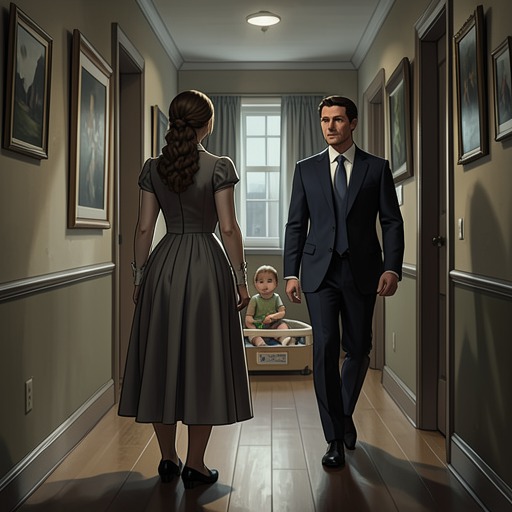
Robert Winchester
The HousemaidRobert Winchester, Andrew’s father and Evelyn’s husband, appears at his son’s funeral as a grieving parent who also offers practical care to Nina and Cecelia. Nina knows little about him and has reason to feel uneasy in his presence: she believes herself responsible for Andrew’s death, while the official account calls it an accident. Robert’s brief appearance offers neither confirmation of what the family knows nor an explanation of what he understood about his son.
Identity and Background
Nina describes Robert as handsome like Andrew, but says she hardly knows him. What she knows of his relationship with his son comes largely from Andrew’s account: Robert was not around much when Andrew was a child, working while Evelyn raised him. This remembered family arrangement gives Robert a limited, indirect presence in the story before the funeral. It also leaves a gap between his role as Andrew’s father and Nina’s knowledge of what kind of father he was.
Robert and Evelyn had returned from Florida for the summer only a few weeks before the funeral. Evelyn had not yet visited Nina, though she had called once to ask whether Nina needed help organizing the service. Nina declined. Robert’s arrival is therefore their first meeting since Andrew’s death, at a moment when Nina is already conscious of the difference between the public explanation and what she believes actually happened.
At Andrew’s Funeral
Robert enters the funeral parlor with Evelyn and walks toward the casket. He wears a dark suit; his eyes are puffy, and his deep, scratchy voice catches as he addresses Nina by name. The physical details and his halting speech convey grief without requiring him to explain it. Nina drops her eyes as the couple approach, then looks up when he clears his throat.
Rather than accuse or question her, Robert tells Nina that he and Evelyn are there for her, that she is not alone, and that she and Cecelia need only ask for help. Nina thanks him and says she appreciates it. The offer is striking in its immediate generosity: it places Nina and Cecelia within the care of Andrew’s family even as Nina privately carries guilt about Andrew’s death. It does not, however, establish what Robert knows about the circumstances of that death.
After speaking with Nina, Robert reaches out and gently touches his son’s shoulder. He then covers his mouth with his hand, shakes his head, and tells Evelyn, “Excuse me” before hurrying out of the room. His grief interrupts the exchange and leaves Nina alone with Evelyn. The small gesture toward the casket and his abrupt departure make his bereavement visible, while offering no clear account of his past relationship with Andrew.
Relationships and Narrative Significance
Robert’s relationships are presented through a sharp contrast between what Nina has heard and what she witnesses. Andrew’s account suggests a father frequently away at work during his childhood; at the funeral, Robert appears as a bereaved parent who reaches out to his son and offers support to the family Andrew left behind. These impressions coexist, but the brief scene does not settle what Robert knew of Andrew’s behavior or how he understood their relationship.
Nina wonders whether Robert had any idea that Andrew could be a monster, or whether Andrew was simply skilled at hiding that side of himself. Her own discovery of the abuse came only when she was trapped in the attic, scraping her fingernails against its door. That recollection underscores the limits of what an observer could know, but it does not answer the question of Robert’s awareness. His kindness at the funeral is therefore not proof of ignorance, complicity, or full understanding; the scene leaves his knowledge unresolved.
The contrast also shapes Robert’s function in the funeral episode. Nina fears that Andrew’s powerful family may know she caused his death, yet Robert offers comfort rather than accusation. His words provide Nina with a moment of human support, while his visible grief prevents that kindness from erasing the loss at the center of the scene. Robert remains a lightly drawn but consequential figure: his conduct complicates Nina’s fear of the Winchesters without resolving the uncertainty surrounding Andrew’s family or the truth of his death.